
myrmepropagandist
futurebird@sauropods.win
I don't know how well this puzzle will translate to a toot. Imagine each line is on a card:
□□▷
□□□
■■
■
□■
□▷▣
▣
□▣
■▷
■▣
▣▷
□□■
□▷
▣▣
□□
□
▣□
□□▣
■□
▷
□▷□
□▷■
▣■
□▷▷
Put them in order.
(The 5th graders could do it, but they did have a helpful example first... There may be more than one solution, but I think there is ONE really good order. Can you find it?)
(I should also mention that every adult I've shown this to gives up. But I only showed it to two rather grouchy teachers.)
 9
9
 3
3
 1
1
myrmepropagandist
futurebird@sauropods.winYeah this is harder without cards to move around and put in arrays. But I think it's still possible.
2
0
1

Dawn Ahukanna
dahukanna@mastodon.social@futurebird order of what?
Make a related, transform sequence starting the first “card”?
1
0
0
myrmepropagandist
futurebird@sauropods.winImagine you have been learning to count in base 2, 3, 4 just before being asked to do this.
However, if the order can be explained with a few simple rules it's valid IMO.
0
0
1


We Must Dissent
MxSpoon@tech.lgbt
@futurebird
This is a question that makes me unreasonably annoyed if not angry. Without having seen an existing order there's huge amount of possible and equally valid sollutions.
Easy one is to arbitarily assign each symbol a number and read the card as base ten, e.g. first one could be 112 or 443. Then there's the question of how each value is ordered. Ascending, descending or by maybe divide them into subgroups by some arcane mathematical rule and order those someway.
Just... Reminds me of school in the Not Good way
1
0
1
myrmepropagandist
futurebird@sauropods.winOk what if I tell you
▷ is first
WRONG: □▷▷ is last
RIGHT: □□▣ is last
I think that narrows down the valid solutions a lot.
I apologize. I gave an unhelpful hint here. It's late.
(I glanced over at the incorrect list.)
0
1
1

Show content
▷ : 0 or 3
□ : 1 or 4
▣ : 2 or 8
■ : 3 or 4
□▷ : 10 or 7
□□ : 11 or 8
□▣ : 12 or 12
□■ : 13 or 8
▣▷ : 20 or 7
▣□ : 21 or 12
▣▣ : 22 or 16
▣■ : 23 or 12
■▷ : 30 or 7
■□ : 31 or 8
■▣ : 32 or 12
■■ : 33 or 8
□▷▷ : 100 or 10
□▷□ : 101 or 11
□▷▣ : 102 or 15
□▷■ : 103 or 11
□□▷ : 110 or 11
□□□ : 111 or 12
□□▣ : 112 or 16
□□■ : 113 or 12
the numbers are my two guesses at a "number value
2
0
0

@futurebird other than 0 which never starts a multi-digit number i don’t see how can one assign other digits to symbols
1
0
0

Show content
@futurebird
which symbol represents which digit is arbitrary but I liked this way
▷
□
▣
■
□▷
□□
□▣
□■
▣▷
▣□
▣▣
▣■
■▷
■□
■▣
■■
□▷▷
□▷□
□▷▣
□▷■
□□▷
□□□
□□▣
□□■
1
0
0
Show content
@futurebird i didn't really feel like i had an "a-ha" while doing this, it only felt like i had the right answer when i sorted them all and realized there were no gaps in the "base 4" ordering, that was the point at which it felt like I had a satisfying answer rather than an arbitrary one
1
0
0

Paul Williams
buddhawilliams@eigenmagic.netShow content
@mcc @futurebird
The Base 4 interpretation is what I ended up with as well, and it felt nice because it was complete with every number from 0 to 113.
But then in another reply you (@futurebird) suggested □▷▷ was the last number but ▷ was the first number and now I am really confused.
▷ really feels like a zero, since it never appears at the beginning of a number. but that would make □▷▷ < □▷□ so □▷▷ can't be largest in my interpretation.
So obviously you have a different solution and I would love to see it!
1
0
0
myrmepropagandist
futurebird@sauropods.winShow content
There is more than one logical order if you want it to be like base 3
But with that restriction I think there are only two.
...
WAIT.
I gave a bad hint.
□□▣ is last.
0
0
0

Mason Loring Bliss
mason@partychickens.net@futurebird I like this. When I teach people about bases, I try to break them free from the symbols having values, and we often end up having them do something in base 3 with circles, squares, and triangles.
1
0
1
 2
0
1
1
0
1
2
0
1
1
0
1
myrmepropagandist
futurebird@sauropods.winWell I feel that there is a logic to:
▷
□
■
▣
But, beyond the triangle I think you can reorder the other three.
1
0
1

sorting into 3 groups by length, then sorting by first glyph in each...
1
0
1

Limnobotanik
Limnobotanik@norden.social@futurebird @apophis ah i would have reversed the two last ones. But that wouldn't make a difference, would it?
0
0
0
the -^ order was entirely arbitrary
*
[
-
^
[*
[[
[-
[^
-*
-[
--
-^
^*
^[
^-
^^
[**
[*[
[*-
[*^
[[*
[[[
[[-
[[^
0
0
0
myrmepropagandist
futurebird@sauropods.winShow content
Two cards that could be flipped where the last two the students fit into their pattern.
They decided that having a repeat made no sense.
0
0
0
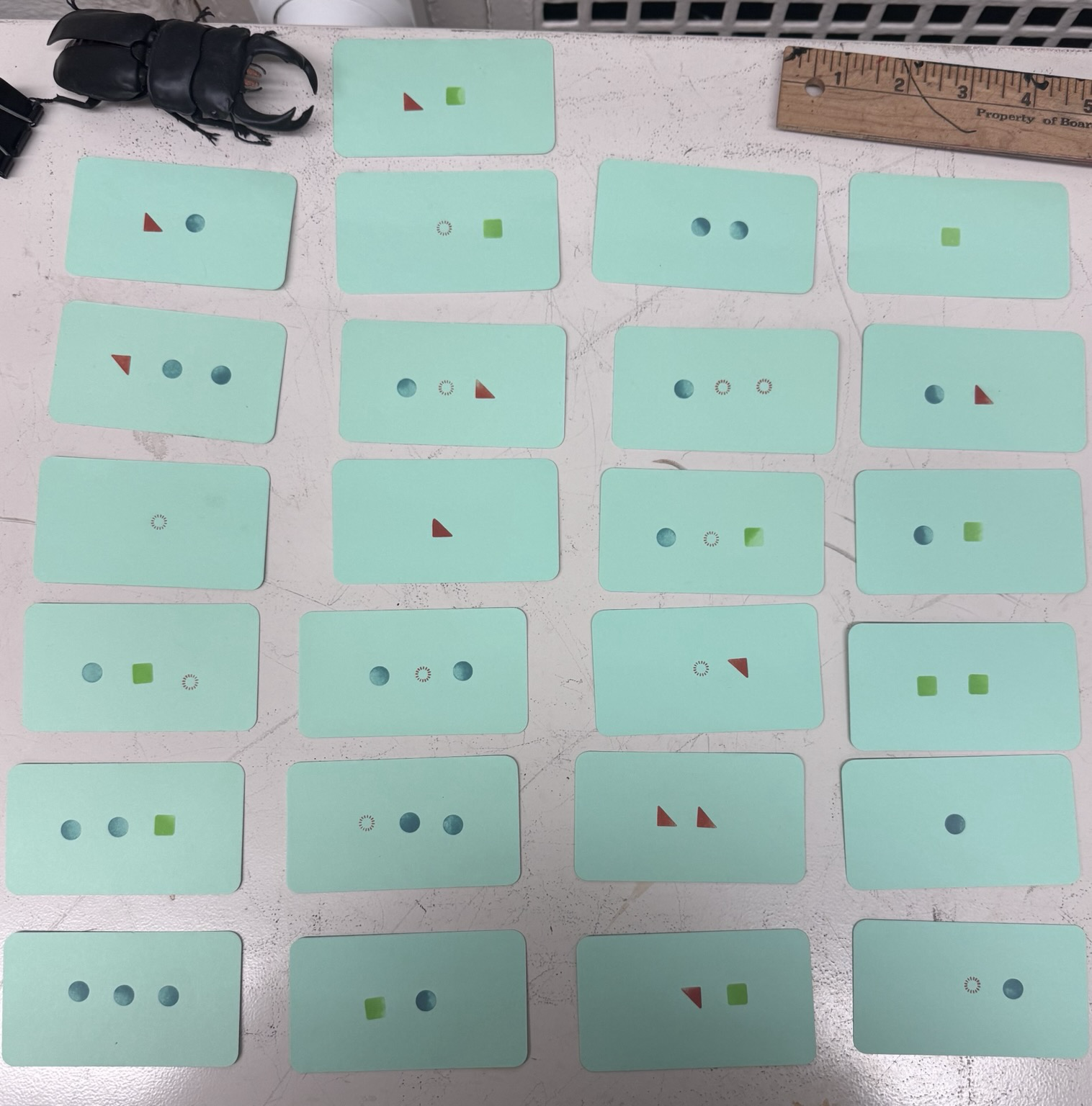

myrmepropagandist
futurebird@sauropods.winHe's very frustrated that it takes so long to move each card to a new location.
0
0
1

Ell 🏳️⚧️
c9a@cathode.churchShow content
@futurebird Okay, after being thoroughly nerdsniped by building a little webapp for this, I finally sat down and did my ordering.
There are a couple small compromises, but overall, this does seem like a nice natural ordering, more or less. Curious how it matches up with others, this was very fun!
My criteria were mainly a) symmetry and b) minimal change between adjacent items. I believe every adjacent pair has a Levenshtein distance of 1.
(For the unfamiliar, that means going from one to the next requires only one change, where the change can be an inserting or deleting one element, swapping two adjacent elements, or changing one element to a different element in the same position)
■
■▷
■□
■▣
■■
□■
□□■
□▷■
□▷▣
□□▣
□▣
▣▣
▣■
▣□
▣▷
▣
□
□□
□□□
□▷□
□▷▷
□□▷
□▷
▷
And here is my fancy overengineered share link 😄 https://cincodenada.com/sortgame/#BAkTCgMFDBYGEggOFxELBxAPAhUYAQ0U
2
0
0
myrmepropagandist
futurebird@sauropods.win1. I'm confused by your ordering. It's not alphabettized, and it's not a base 4 analog. That doesn't mean it's not logical, hmmm.
2. I'm impressed by the little application. What language did you use? My CS club students are making some web games and they want to do things like save scores and let users compare answers so this could work.
As such JavaScript isn't sufficent. Too client side. We've been trying PHP.
I used to be a web dev but that was two decades ago.
1
1
0
Ell 🏳️⚧️
c9a@cathode.churchShow content
@futurebird Ha, just read the rest of the thread, and with the hints, yeah I see how a nice base 4 ordering falls out. I still do like my ordering aesthetically though, and now I wonder how many orderings there are that accomplish my Levenshtein criteria, and also if that maps interestingly to base 4 numbers 🤔
0
0
0

Luci Bitchface Angerfoot
bri7@social.treehouse.systems@futurebird @c9a looking at the criteria, it’s a valid grey code, making it transformable to a base 4 ordering by reflection rules, and also transformable to a valid towers of hanoi solution
in theory. i haven’t validated any of these claims
2
0
0
Luci Bitchface Angerfoot
bri7@social.treehouse.systems@futurebird @c9a if valid, by “reflection rules” i mean that splitting it in half, and reversing one of the halves… then repeating on each half recursively, should result in a base4
0
0
0